When importing sintered stone slabs, weight is important for more than freight calculation. It affects container loading, local road limits, unloading equipment, storage racks and installation planning.
As a quick reference, sintered stone normally weighs about 14.4–15 kg per m² for every 6 mm of thickness. In imperial units, this is approximately 2.95–3.07 lb per sq ft. A 12 mm slab therefore weighs roughly twice as much as a 6 mm slab of the same size.
However, the exact weight and container quantity depend on the slab size, thickness, body density, packaging method and legal payload limit. This guide shows B2B buyers how to estimate both slab weight and the number of square metres that a container can carry.
What Is the Typical Density of Sintered Stone?
Most sintered stone has a density of approximately 2,400–2,500 kg/m³, equal to about 150–156 lb/ft³.
The actual density varies slightly according to the raw materials, pressing process and product body. Full-body products and different surface treatments may also produce small variations. For an exact order, the factory should confirm the real weight shown on the packing list rather than relying only on a theoretical calculation.
Sintered Stone Weight per Square Metre and Square Foot
The following table uses a density range of 2,400–2,500 kg/m³.
| Thickness | Approx. weight per m² | Approx. weight per sq ft |
|---|---|---|
| 6 mm | 14.4–15.0 kg (31.7–33.1 lb) | 1.34–1.39 kg (2.95–3.07 lb) |
| 9 mm | 21.6–22.5 kg (47.6–49.6 lb) | 2.01–2.09 kg (4.42–4.61 lb) |
| 12 mm | 28.8–30.0 kg (63.5–66.1 lb) | 2.68–2.79 kg (5.90–6.14 lb) |
| 15 mm | 36.0–37.5 kg (79.4–82.7 lb) | 3.34–3.48 kg (7.37–7.68 lb) |
| 20 mm | 48.0–50.0 kg (105.8–110.2 lb) | 4.46–4.65 kg (9.83–10.24 lb) |
These figures are the net weight of the material. They do not include protective film, wooden crates, steel A-frames, pallets or other packaging.
How to Calculate the Weight of One Sintered Stone Slab
Use this formula:
Slab weight (kg) = length (m) × width (m) × thickness (m) × density (kg/m³)
To convert kilograms to pounds:
Weight in lb = weight in kg × 2.2046
For example, a 1,600 × 3,200 × 12 mm slab has an area of 5.12 m². Using a density of 2,400–2,500 kg/m³:
5.12 × 0.012 × 2,400–2,500 = approximately 147.5–153.6 kg
That is approximately 325–339 lb per slab.
Typical Weight of Common Sintered Stone Slab Sizes
| Slab size | Thickness | Area | Approx. net weight per slab |
| 1,200 × 2,400 mm | 6 mm | 2.88 m² | 41.5–43.2 kg (91–95 lb) |
| 1,200 × 2,400 mm | 9 mm | 2.88 m² | 62.2–64.8 kg (137–143 lb) |
| 1,200 × 2,400 mm | 12 mm | 2.88 m² | 82.9–86.4 kg (183–190 lb) |
| 800 × 2,600 mm | 9 mm | 2.08 m² | 44.9–46.8 kg (99–103 lb) |
| 900 × 2,700 mm | 9 mm | 2.43 m² | 52.5–54.7 kg (116–121 lb) |
| 1,600 × 3,200 mm | 6 mm | 5.12 m² | 73.7–76.8 kg (163–169 lb) |
| 1,600 × 3,200 mm | 12 mm | 5.12 m² | 147.5–153.6 kg (325–339 lb) |
| 1,600 × 3,200 mm | 20 mm | 5.12 m² | 245.8–256.0 kg (542–564 lb) |
These are theoretical net weights. Manufacturing tolerances and attached mesh or backing may change the actual weight.
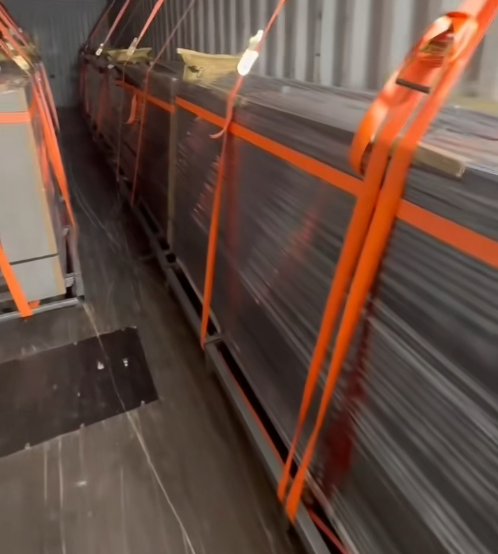
How Many Square Metres of Sintered Stone Can One Container Load?
For slab shipments, the container is often limited by weight before all its internal volume is used. A 40HQ container therefore does not automatically carry twice as much sintered stone as a 20GP container.
For preliminary planning, the following ranges assume approximately 24,000–26,000 kg (52,900–57,300 lb) of net stone after allowing for crates or racks. They are estimates, not guaranteed loading quantities.
| Thickness | Estimated net stone area by weight | Typical planning range after practical loading factors |
| 6 mm | 1,600–1,806 m² | about 1,450–1,750 m² |
| 9 mm | 1,067–1,204 m² | about 950–1,150 m² |
| 12 mm | 800–903 m² | about 720–860 m² |
| 15 mm | 640–722 m² | about 580–690 m² |
| 20 mm | 480–542 m² | about 430–520 m² |
The actual quantity for either a 20GP or 40HQ must be checked against the container payload, rack layout and slab dimensions. A 20GP is often efficient for dense stone products, while a 40HQ may be selected when tall slabs or the loading-frame arrangement require more internal space.
Example: Container Capacity for 1,200 × 2,400 × 9 mm Slabs
One 1,200 × 2,400 × 9 mm slab weighs approximately 62.2–64.8 kg (137–143 lb) and covers 2.88 m².
If the shipment allows 24,000–26,000 kg (52,900–57,300 lb) of net stone, the theoretical result is approximately:
- 370–418 slabs
- 1,066–1,204 m²
- 11,474–12,960 sq ft
The confirmed quantity may be lower after considering the weight and dimensions of the steel frames, wooden crates, protective materials and internal bracing.
Why Can the Actual Container Quantity Be Different?
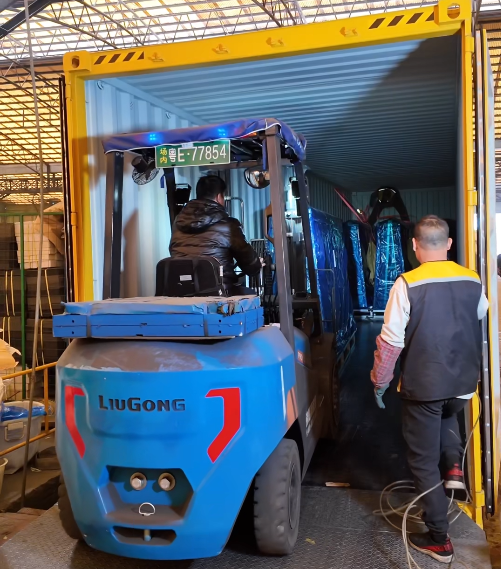
1. Container payload limit
The maximum gross weight printed on the container door is not the same as the available cargo weight. The tare weight of the empty container must be deducted. Shipping-line rules and local road weight limits may reduce the usable payload further.
2. Packaging weight
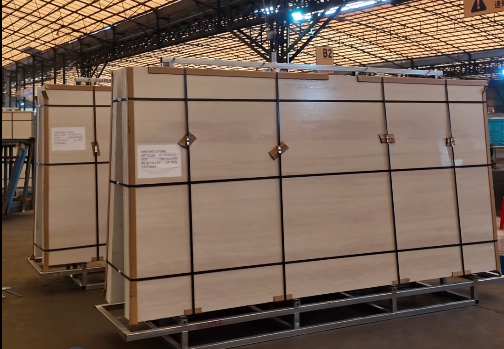
Large slabs are normally packed on reinforced wooden or steel frames. The gross cargo weight includes the stone, frames, protective boards, straps and other materials.
3. Slab dimensions and rack layout
The internal dimensions of a 20GP and 40HQ are different. Large-format slabs may require a specific rack angle, clearance and securing space. Physical layout can limit the number of racks even when some payload remains.
4. Product thickness and actual body weight
Thicker slabs reduce the available square metres quickly. Actual product weight can also vary between collections, so the final calculation should use the confirmed weight per piece.
5. Mixed-size or mixed-thickness orders
A container containing several sizes or thicknesses needs a piece-by-piece calculation. Loading must also keep the weight balanced and allow safe securing.
What Information Should Buyers Confirm Before Shipping?

Before approving a container loading plan, ask the supplier to provide:
- exact slab size, thickness and quantity;
- actual net weight per slab in kg and lb;
- total net and gross cargo weight;
- number, dimensions and weight of the racks or crates;
- proposed 20GP or 40HQ loading layout;
- container payload and destination road-weight restrictions;
- packing list and loading photos after completion.
This information is more reliable than choosing a container based only on its volume.
Frequently Asked Questions
Is sintered stone heavier than quartz?
At the same thickness, their weights can be similar because both materials are dense. The final comparison depends mainly on the exact product density and thickness. Sintered stone is often supplied in thinner formats, which can make the finished slab lighter.
How much does a 12 mm sintered stone slab weigh?
A 12 mm slab weighs approximately 28.8–30 kg per m² (63.5–66.1 lb per m²). A 1,600 × 3,200 mm slab therefore weighs about 147.5–153.6 kg (325–339 lb).
How much does a 20 mm sintered stone slab weigh?
A 20 mm slab weighs approximately 48–50 kg per m² (105.8–110.2 lb per m²). A 1,600 × 3,200 mm slab weighs about 245.8–256 kg (542–564 lb).
Can a 40HQ carry more sintered stone than a 20GP?
It can provide more space and may suit taller slabs or a different rack layout. However, both containers may become weight-limited, so a 40HQ does not necessarily carry proportionally more square metres.
How can I get an exact loading quantity?
Send the supplier the required slab size, thickness, finish and destination. The supplier can calculate the number of pieces, square metres, rack arrangement and gross weight for the specific order.
Final Thoughts
Sintered stone generally weighs 14.4–15 kg per m² at 6 mm thickness, 21.6–22.5 kg per m² at 9 mm, and 28.8–30 kg per m² at 12 mm. Container capacity should be calculated from both weight and rack layout, not container volume alone.
BJS supplies sintered stone in multiple sizes, thicknesses, full-body designs and textured finishes. If you send us your required specification and destination port, we can prepare a practical loading estimate for your order.