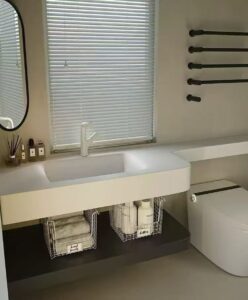
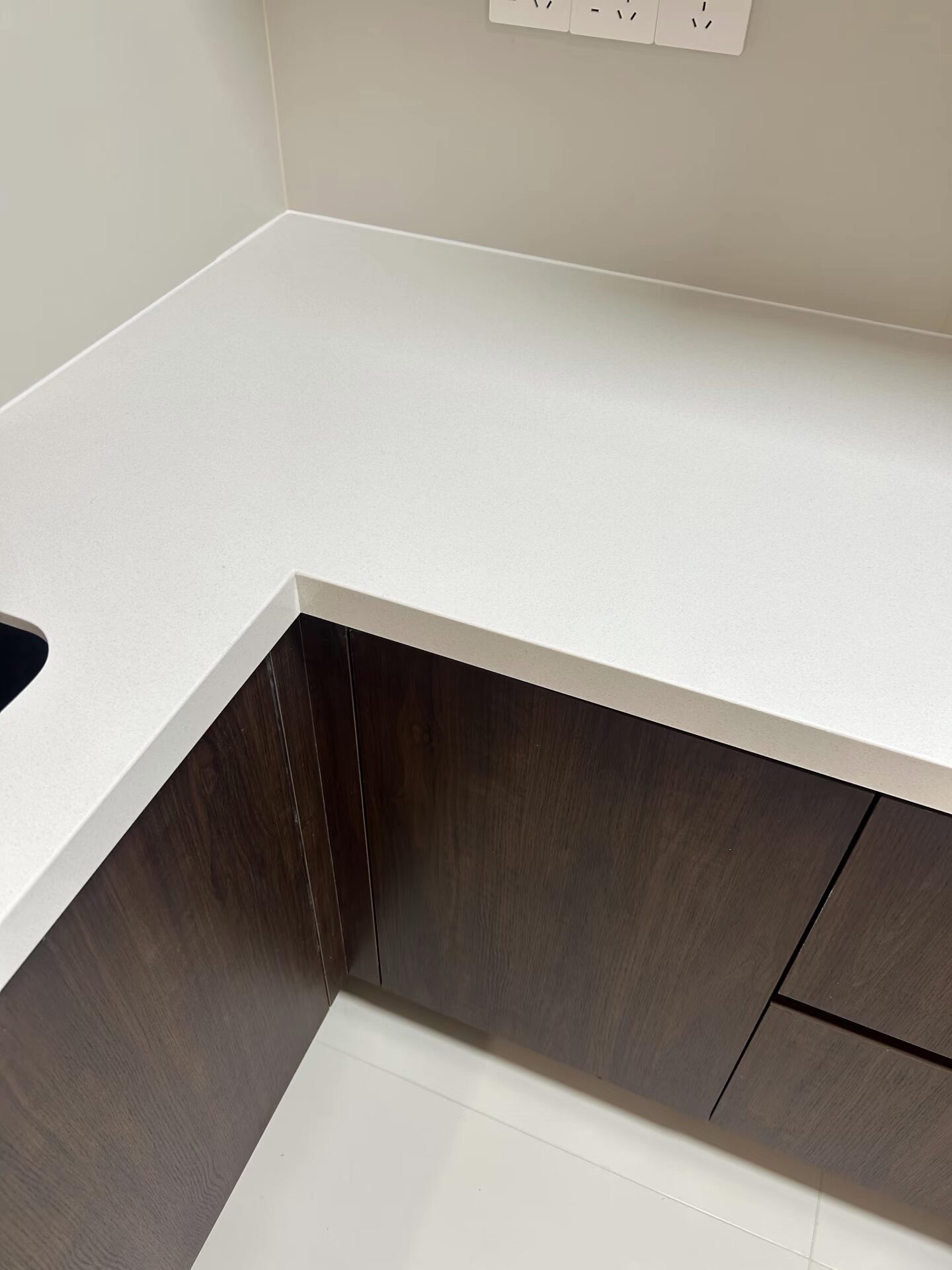
Choosing the right kitchen slab is not only about color and pattern. The material must also handle heat, stains, scratches, moisture, and daily cleaning.
Sintered stone, quartz, and granite are three of the most popular materials for kitchen countertops. Each has its own advantages, limitations, fabrication requirements, and price range.
So, which is the best slab for a kitchen?
For most modern kitchens, sintered stone offers the best overall combination of heat resistance, stain resistance, design flexibility, and low maintenance. Quartz is practical for indoor residential kitchens, while granite remains a strong choice for buyers who prefer natural stone.
This guide compares the three materials to help homeowners, designers, fabricators, cabinet manufacturers, and project buyers make the right decision.
Quick Comparison: Sintered Stone vs Quartz vs Granite
| Feature | Sintered Stone | Quartz | Granite |
|---|---|---|---|
| Material type | Manufactured from natural minerals | Engineered mineral surface with resin | Natural igneous stone |
| Heat resistance | Excellent | Moderate | Very good |
| Stain resistance | Excellent | Excellent | Good when properly sealed |
| Scratch resistance | Excellent | Good | Very good |
| Water absorption | Very low | Very low | Varies by stone |
| UV resistance | Generally excellent | Usually not recommended outdoors | Generally good |
| Maintenance | Low | Low | Moderate |
| Sealing required | No | No | Usually yes |
| Pattern consistency | High | High | Naturally variable |
| Large-format availability | Excellent | Good | Depends on the natural block |
| Fabrication difficulty | Requires proper tools and experience | Relatively familiar to fabricators | Heavy and requires stoneworking equipment |
| Best application | Modern indoor and outdoor kitchens | Indoor residential kitchens | Natural-style kitchens |
1. What Is a Sintered Stone Kitchen Slab?
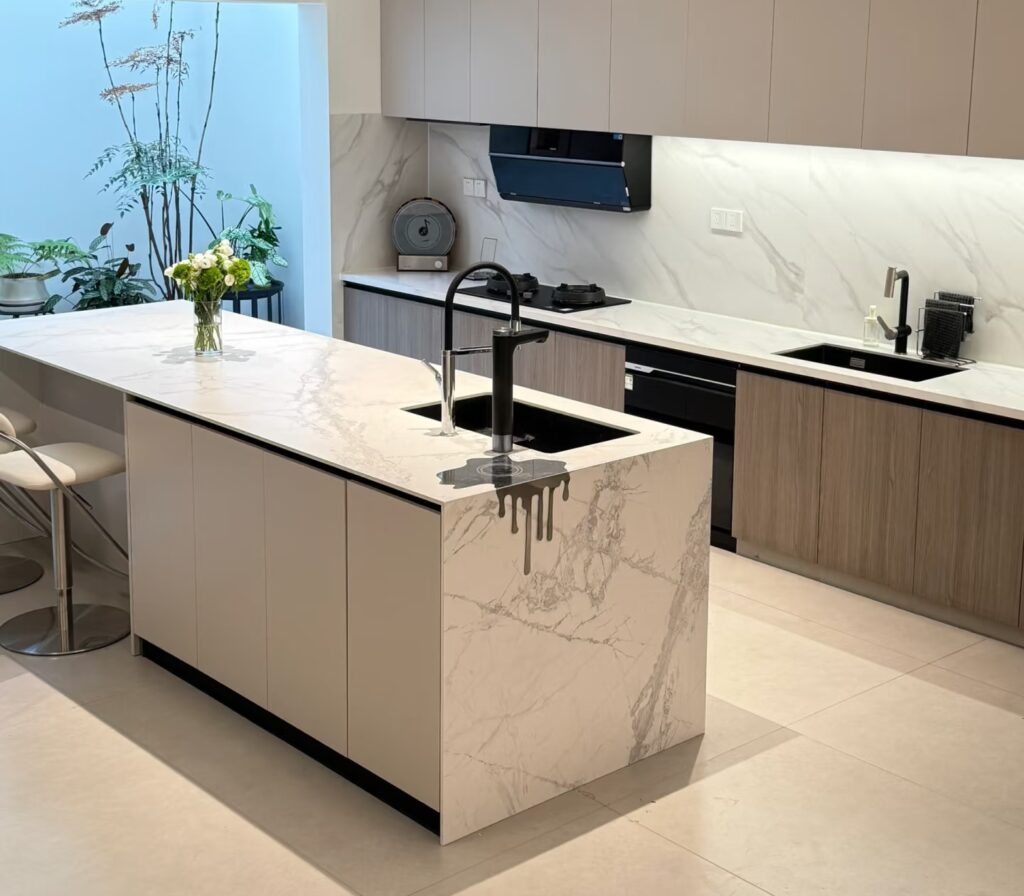
Sintered stone is made from selected natural minerals that are compacted under high pressure and fired at high temperatures. This process creates a dense and durable surface without relying on resin as the main binding material.
A sintered stone kitchen slab is commonly used for:
- Kitchen countertops
- Waterfall islands
- Backsplashes
- Cabinet panels
- Dining tables
- Integrated sinks
- Indoor and outdoor kitchens
Its low water absorption helps protect the surface against common kitchen stains, including coffee, oil, sauces, and wine. It also has strong resistance to heat, scratches, UV exposure, and household cleaning products.
Large-format production is another important advantage. A large kitchen slab can cover a countertop, island, or backsplash with fewer joints, creating a cleaner and more continuous appearance.
Advantages of Sintered Stone
Excellent heat resistance
Sintered stone performs well around cooktops and other high-temperature kitchen areas. This makes it more suitable for heat-intensive applications than many resin-based countertop materials.
Using a trivet is still a sensible daily habit because direct heat can affect adhesives, cabinets, joints, and other parts of the installation.
Low water absorption
The surface is highly resistant to liquid penetration. It normally does not require sealing, making daily cleaning and long-term maintenance easier.
Strong stain and scratch resistance
Sintered stone can handle most common kitchen activities without easily developing permanent stains or scratches.
However, highly polished surfaces may show fine marks more easily than matte or textured finishes. Buyers should evaluate the actual finish rather than assuming every surface performs in exactly the same way.
Suitable for outdoor kitchens
Many sintered stone products have good UV resistance and can be used in outdoor kitchens. This is an important difference between sintered stone and many quartz surfaces, which may discolor after long-term sunlight exposure.
Wide choice of designs
Sintered stone can reproduce the appearance of marble, limestone, travertine, concrete, metal, and other materials. Buyers can choose from different colors, textures, thicknesses, and body structures.
Full-body sintered stone is particularly useful for exposed edges, grooves, and other detailed fabrication because its internal body is designed to coordinate with the surface.
Limitations of Sintered Stone
Sintered stone is hard but not impossible to damage.
Edges and corners can chip if the slab is handled incorrectly or if cutouts are fabricated without proper tools. Sink and cooktop cutouts must have suitable corner radiuses, and installers should make sure the cabinets and substrate are level.
Fabricators also need professional cutting blades, stable equipment, and experience with large-format slabs. Choosing the right fabricator is just as important as choosing the material.
2. What Is a Quartz Kitchen Slab?
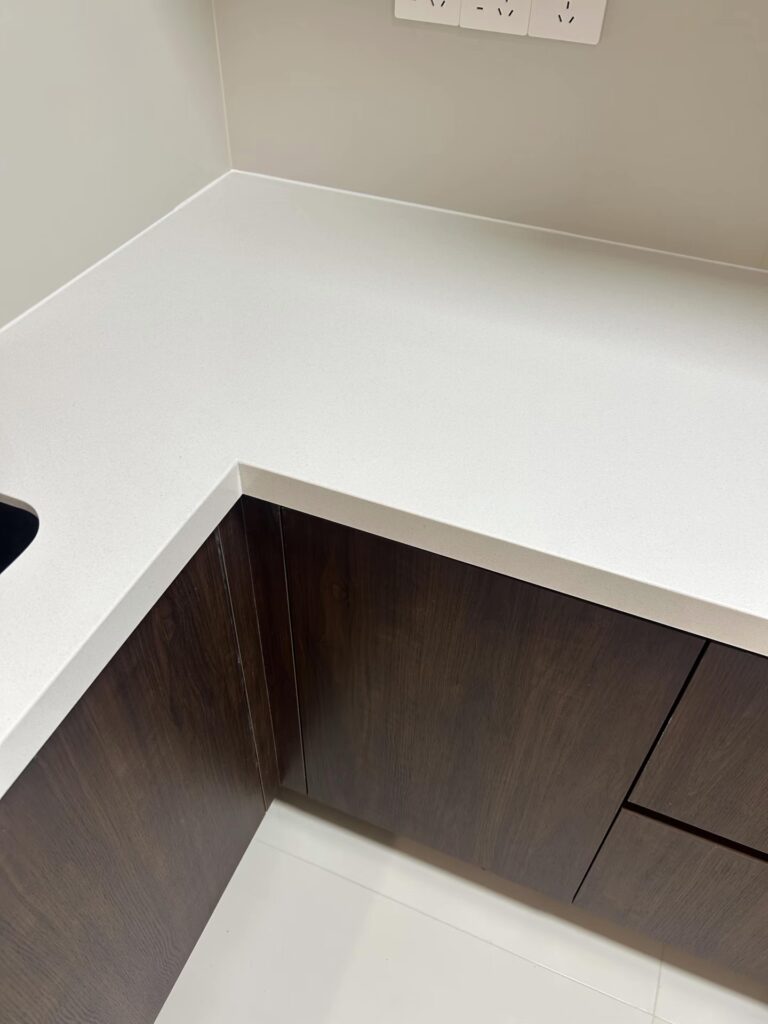
Quartz countertops are engineered surfaces made from minerals combined with binders, pigments, and other ingredients. Their exact composition varies between manufacturers and product generations.
Quartz kitchen slabs are popular because they offer consistent patterns, low water absorption, and relatively simple maintenance.
They are widely used for apartment kitchens, residential developments, vanity tops, and standard indoor countertops.
Advantages of Quartz
Consistent appearance
Quartz provides predictable colors and patterns. This makes it easier to match multiple slabs across a large residential project.
Good stain resistance
Its low-porosity surface is easy to clean and normally does not require sealing.
Familiar fabrication process
Many countertop fabricators already have experience cutting and installing quartz. This may make local fabrication and installation easier in some markets.
Wide market availability
Quartz is widely available in different colors, patterns, and price levels. Buyers can usually find options for entry-level, mid-range, and premium projects.
Limitations of Quartz
The main limitation is heat resistance.
Quartz surfaces contain binding materials that can be affected by high temperatures or rapid temperature changes. Manufacturers commonly recommend using trivets under hot cookware. For example, Silestone advises thermal protection for high-temperature objects and lists thermal-shock resistance up to 180°C for applicable products.
Quartz is also generally intended for indoor use. Long-term UV exposure may cause discoloration or changes in the resin, so it is not normally the first choice for an uncovered outdoor kitchen.
Its patterns are controlled and consistent, but some products may look less natural than granite or premium sintered stone with detailed textures.
3. What Is a Granite Kitchen Slab?
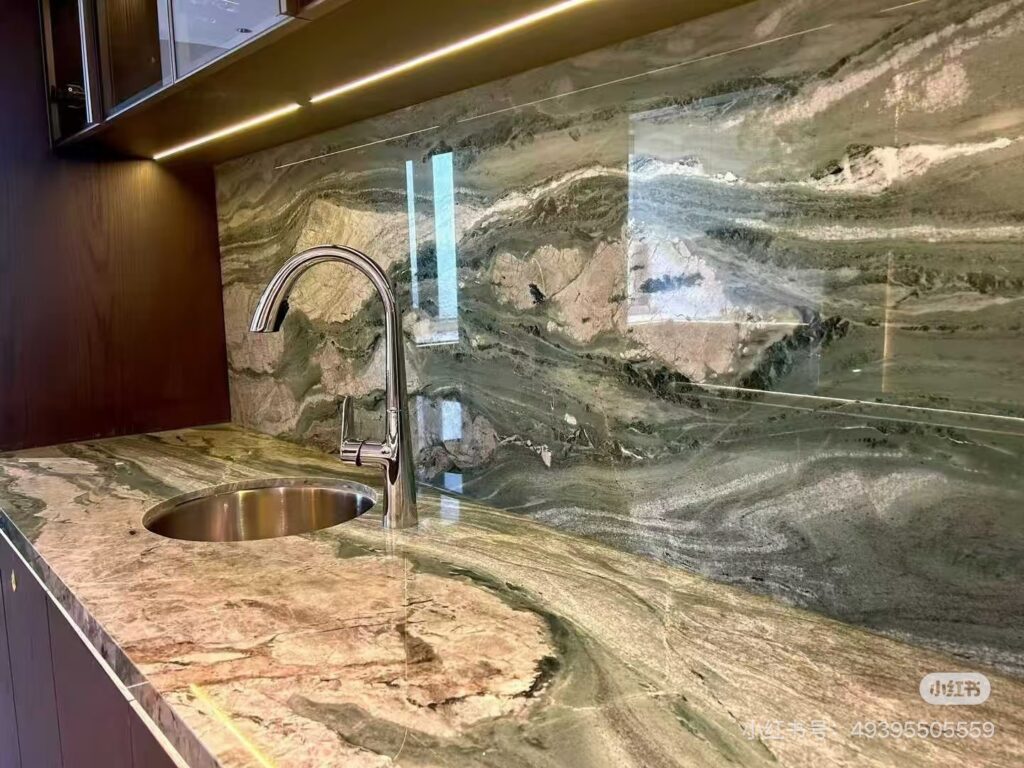
Granite is a natural igneous rock formed as molten material cools and crystallizes underground. Every granite slab has its own mineral structure, color variation, and natural movement.
For buyers who value genuine natural stone, granite remains an attractive kitchen countertop material.
Advantages of Granite
Natural and unique appearance
No two granite slabs are completely identical. This natural variation gives each kitchen a distinctive look.
Good heat resistance
Granite generally performs well around heat, although using trivets is still recommended to protect the countertop and surrounding installation.
Strong surface
Quality granite can provide very good scratch and wear resistance, making it suitable for busy kitchens.
Suitable for traditional and luxury projects
Granite works well in interiors where natural materials and individual stone patterns are part of the design concept.
Limitations of Granite
Granite is naturally variable.
Colors, veins, mineral spots, and surface characteristics can change between slabs, even when they come from the same quarry. Buyers should inspect the actual slabs or approve detailed photos before cutting.
Most granite countertops also need to be properly sealed. The sealing schedule depends on the specific stone, finish, installation, and usage conditions.
Granite is heavy, and some colors or patterns may be difficult to source consistently for large projects. Matching replacement pieces at a later stage may also be challenging.
Which Kitchen Slab Has the Best Heat Resistance?
Sintered stone is generally the strongest option of the three for kitchens where heat resistance is a priority.
Granite also handles heat well, but its performance can vary according to the stone and installation. Quartz offers some heat resistance, but direct contact with very hot cookware can damage or discolor the binding material.
For kitchens with frequent cooking, commercial-style appliances, or countertop areas close to grills and cooktops, sintered stone is usually the more practical choice.
Which Material Is Easiest to Maintain?
Sintered stone and quartz are both low-maintenance kitchen slab materials.
Their low water absorption makes everyday spills easier to clean, and neither normally requires periodic sealing. For regular maintenance, warm water, a soft cloth, and a suitable neutral cleaner are usually enough.
Granite can also be easy to maintain after correct sealing, but the owner may need to check and renew the sealer over time.
If minimum maintenance is one of the main purchasing requirements, sintered stone or quartz will normally be more convenient than granite.
Which Kitchen Slab Looks the Most Natural?
Granite is the only completely natural stone in this comparison. Its variation, crystals, and irregular movement are difficult to duplicate exactly.
However, modern sintered stone production can create detailed marble-look and stone-look patterns with textured finishes. These products provide a natural visual effect while offering more control over color consistency and slab matching.
Quartz also offers stone-inspired patterns, but the level of depth and surface texture depends heavily on the brand and product range.
For buyers who want a one-of-a-kind natural surface, granite is the better option. For buyers who want a natural-stone appearance with more consistent supply, sintered stone is usually easier to manage.
Which Material Is Better for Large Kitchen Islands?
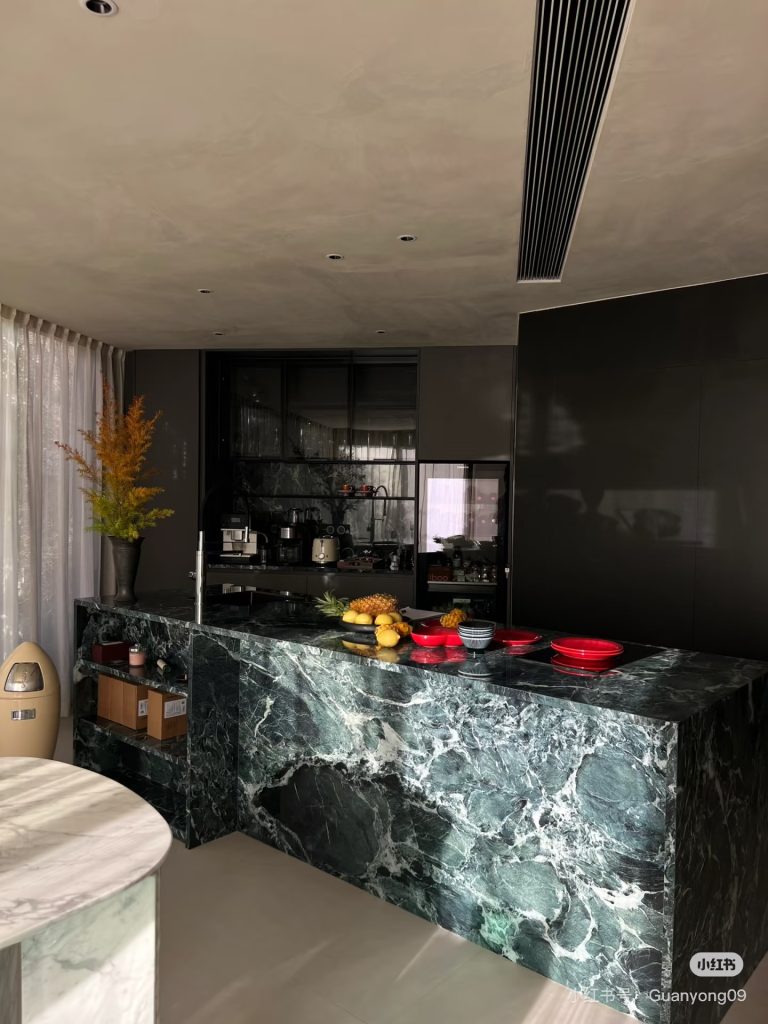
Sintered stone is particularly suitable for large islands because it is available in large slab sizes and multiple thicknesses.
Large-format slabs can reduce the number of visible joints on:
- Long countertops
- Waterfall edges
- Full-height backsplashes
- Oversized islands
- Cabinet doors and side panels
Pattern planning is still important. For marble-look products, the fabricator should check vein direction before cutting the countertop and waterfall panels.
Quartz is also available in large formats, but the available dimensions depend on the manufacturer. Granite slab size is limited by the dimensions and quality of the natural block.
What Is the Best Thickness for a Kitchen Slab?
The correct thickness depends on the material, countertop design, support structure, edge profile, and local fabrication method.
For sintered stone kitchen countertops, 12 mm is a common choice because it provides a good balance between strength and weight. Thicker options, such as 15 mm or 20 mm, may be used for specific fabrication requirements or a more substantial appearance.
A 6 mm slab is normally more suitable for wall cladding, cabinet panels, or renovation overlays than for a standard unsupported countertop.
A thicker visual edge does not always require a solid thick slab. Fabricators can create a laminated or mitred edge to achieve a 40 mm or thicker appearance while controlling total weight.
Before ordering, buyers should confirm the following details with the fabricator:
- Slab thickness
- Cabinet support
- Maximum unsupported span
- Sink and cooktop cutout details
- Edge profile
- Overhang dimensions
- Joint positions
- Installation adhesive and substrate
Sintered Stone, Quartz, or Granite: Which Should You Choose?
Choose sintered stone if you need:
- Strong heat, stain, scratch, and UV resistance
- A low-maintenance countertop
- Large slabs with fewer joints
- Indoor and outdoor kitchen applications
- Marble-look or textured designs
- Matching countertops, islands, backsplashes, and cabinet panels
- Consistent supply for multi-unit projects
Choose quartz if you need:
- A practical indoor countertop
- Consistent colors and patterns
- Easy local fabrication
- Low maintenance
- A broad selection across different price levels
Choose granite if you need:
- Genuine natural stone
- A unique pattern in every slab
- Good heat and wear resistance
- A traditional or natural luxury appearance
- A material that can be selected slab by slab
What Should B2B Buyers Check Before Ordering Kitchen Slabs?

For distributors, fabricators, cabinet factories, and project buyers, material performance is only part of the purchasing decision.
Before placing an order, confirm:
- Actual slab size and usable size
The usable area may be slightly smaller than the nominal dimensions because of edge trimming or production tolerances.
- Thickness tolerance
Check whether the thickness is suitable for your machinery, edge processing, and support system.
- Surface finish
Matte, polished, textured, and dry-grain finishes can have different cleaning, reflection, and scratch-visibility characteristics.
- Pattern continuity
For kitchen islands and waterfall edges, confirm whether book-matched, continuous, or random layouts are required.
- Body type
If the design includes exposed edges or detailed grooves, compare regular-body and full-body sintered stone options.
- Fabrication tests
Test cutting, drilling, edge polishing, and mitre processing before starting a large project.
- Batch consistency
For multi-unit kitchens, order enough material from the same production batch whenever possible.
- Packing method
Large slabs need strong export packaging. Confirm the rack structure, slab protection, loading direction, and container securing method before shipment.
- Replacement quantity
Consider ordering extra material for fabrication loss, breakage, future repair, or project changes.
- Technical documents
Ask the supplier for available test reports, technical data, care instructions, and fabrication guidance.
Final Verdict: What Is the Best Slab for a Kitchen?
There is no single material that is best for every kitchen.
Quartz is a practical and widely available choice for indoor residential projects. Granite offers genuine natural character and strong performance. Sintered stone provides the most balanced solution for buyers who need heat resistance, low maintenance, large formats, design consistency, and both indoor and outdoor applications.
For modern countertops, large kitchen islands, waterfall edges, and multi-unit projects, sintered stone is often the most versatile option.
BJS supplies sintered stone kitchen slabs in a wide range of designs, finishes, body types, sizes, and thicknesses. Full-body products, textured surfaces, large inventory, hot-bend applications, and flexible custom production are available for different markets and project requirements.
If you are sourcing slabs for kitchen countertops, cabinet production, distribution, or a construction project, contact us with your required size, thickness, finish, quantity, and destination port. We can recommend suitable options for your market and fabrication method.
Frequently Asked Questions
Is sintered stone better than quartz for kitchen countertops?
Sintered stone is generally better for buyers who prioritize heat resistance, UV resistance, outdoor use, and large-format applications. Quartz remains a practical option for standard indoor kitchens and may be easier to fabricate in markets where quartz processing is already common.
Does sintered stone scratch easily?
Quality sintered stone has strong scratch resistance, but no countertop should be treated as completely scratch-proof. Scratch visibility can also vary according to the color and finish. It is still advisable to use a cutting board.
Can hot pans be placed on a sintered stone countertop?
Sintered stone has excellent heat resistance. However, using a trivet remains good practice because heat may affect joints, adhesives, sealants, cabinets, and nearby materials.
Does granite need to be sealed?
Many granite countertops need sealing because natural stone can absorb liquids. The actual requirement depends on the granite variety, finish, and usage conditions.
Can quartz kitchen slabs be used outdoors?
Quartz is generally not recommended for uncovered outdoor applications because long-term UV exposure can affect its color and binding materials. Always check the manufacturer’s technical instructions.
What thickness of sintered stone is best for a kitchen countertop?
A 12 mm sintered stone slab is a common countertop choice. However, the final thickness should be selected according to the support structure, slab dimensions, cutouts, overhangs, edge design, and the supplier’s fabrication guidance.