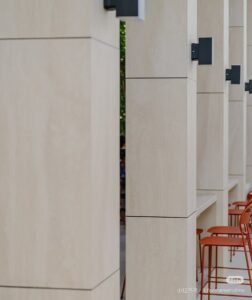
Sintered stone has become a popular choice for kitchens, bathrooms, furniture, wall cladding, and commercial interiors. It offers the visual appeal of natural stone while giving designers and fabricators a manufactured surface with consistent patterns and practical performance.

What is sintered stone?
Sintered stone is an engineered slab made from selected mineral materials that are compacted and treated under very high pressure and heat. The process creates a dense surface with a stone-like appearance. Depending on the design, a slab can reproduce the look of marble, limestone, concrete, wood, or other natural materials.
Unlike a natural stone block that is cut from a quarry, sintered stone is produced to a controlled specification. This gives buyers more consistent thickness, repeatable colours, and a wider range of surface finishes.
Why do buyers choose sintered stone?
- Durable surface: It is designed for demanding residential and commercial applications.
- Low water absorption: Its dense structure makes it suitable for areas where easy cleaning matters.
- Design flexibility: Large slabs and coordinated patterns support worktops, islands, splashbacks, walls, and furniture.
- Easy everyday care: Most daily spills can be removed with a soft cloth and a suitable mild cleaner.
- Consistent supply: Factory production can provide more predictable colour and thickness than some natural materials.
Where can sintered stone be used?
In residential projects, common applications include kitchen worktops, islands, bathroom vanities, shower walls, dining tables, fireplaces, and interior feature walls. The right thickness and fabrication method depend on the application.

For commercial projects, sintered stone can be used in hospitality counters, retail displays, reception desks, public interiors, and exterior cladding systems where the project specification allows it. In hot, dry, coastal, or high-use environments, buyers should confirm that the selected product, installation method, and supporting structure are appropriate for the location.
Sintered stone compared with other surfaces
Sintered stone vs. natural stone
Natural stone has unique variation and a long-established premium appearance. Sintered stone provides more controlled colour and pattern options, together with a manufactured format that can be easier to specify across a larger project. The best choice depends on the desired appearance, fabrication requirements, maintenance expectations, and budget.
Sintered stone vs. porcelain
These materials can look similar and may overlap in some applications. Buyers should compare the actual slab specification rather than relying only on the product name. Check the recommended uses, thicknesses, finish, fabrication guidance, available sizes, and support available from the supplier.
Sintered stone vs. quartz
Quartz is widely used for interior worktops and has its own design and performance advantages. Sintered stone is often considered when buyers want a mineral-based surface with strong visual depth, large-format options, and suitability for a wider range of design applications. Project requirements should determine the final selection.
What should you check before buying?
- Application: Tell the supplier whether the slab is for a kitchen, bathroom, furniture, wall, commercial interior, or exterior project.
- Slab size and thickness: Confirm the available dimensions and whether they suit your cutting plan.
- Finish and pattern: Request real slab images or samples because screens may not show the exact colour and texture.
- Fabrication guidance: Ask about cutting tools, edge details, sink openings, corners, and installation support.
- Batch consistency: For larger projects, confirm how colour matching and replacement slabs will be handled.
- Packaging and delivery: Check pallet protection, loading method, lead time, and export documentation.
- After-sales support: A reliable supplier should be able to answer technical and installation questions after the order.

How to choose a sintered stone supplier
Look beyond the catalogue. A capable supplier should be able to explain the manufacturing process, provide clear product specifications, show real applications, and support your fabricator or project team. For importers and distributors, supply capacity, packaging, communication, sample service, and replacement support are also important.
BJS sintered stone supports customers looking for coordinated slab designs, project applications, and export supply. Contact BJS sintered stone sales for product recommendations, samples, and project support.
Frequently asked questions
Is sintered stone suitable for kitchen worktops?
It can be suitable for kitchen worktops when the selected slab, thickness, edge design, fabrication process, and installation method match the project requirements.
Is sintered stone difficult to maintain?
Routine care is generally straightforward. Clean spills promptly, use suitable mild cleaners, and follow the supplier’s care instructions for the selected finish.
Can I use the same slab indoors and outdoors?
Do not assume that every slab and finish is suitable for every environment. Confirm the recommended application, local conditions, installation details, and warranty terms with the supplier.
Final thoughts
Sintered stone is worth considering when a project needs a durable, design-led surface with consistent supply and a broad range of applications. The right decision depends on more than appearance: compare the slab specification, fabrication guidance, logistics, and supplier support before placing an order.