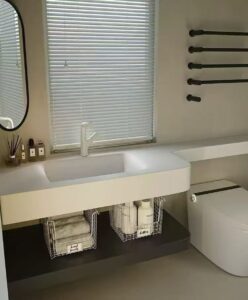
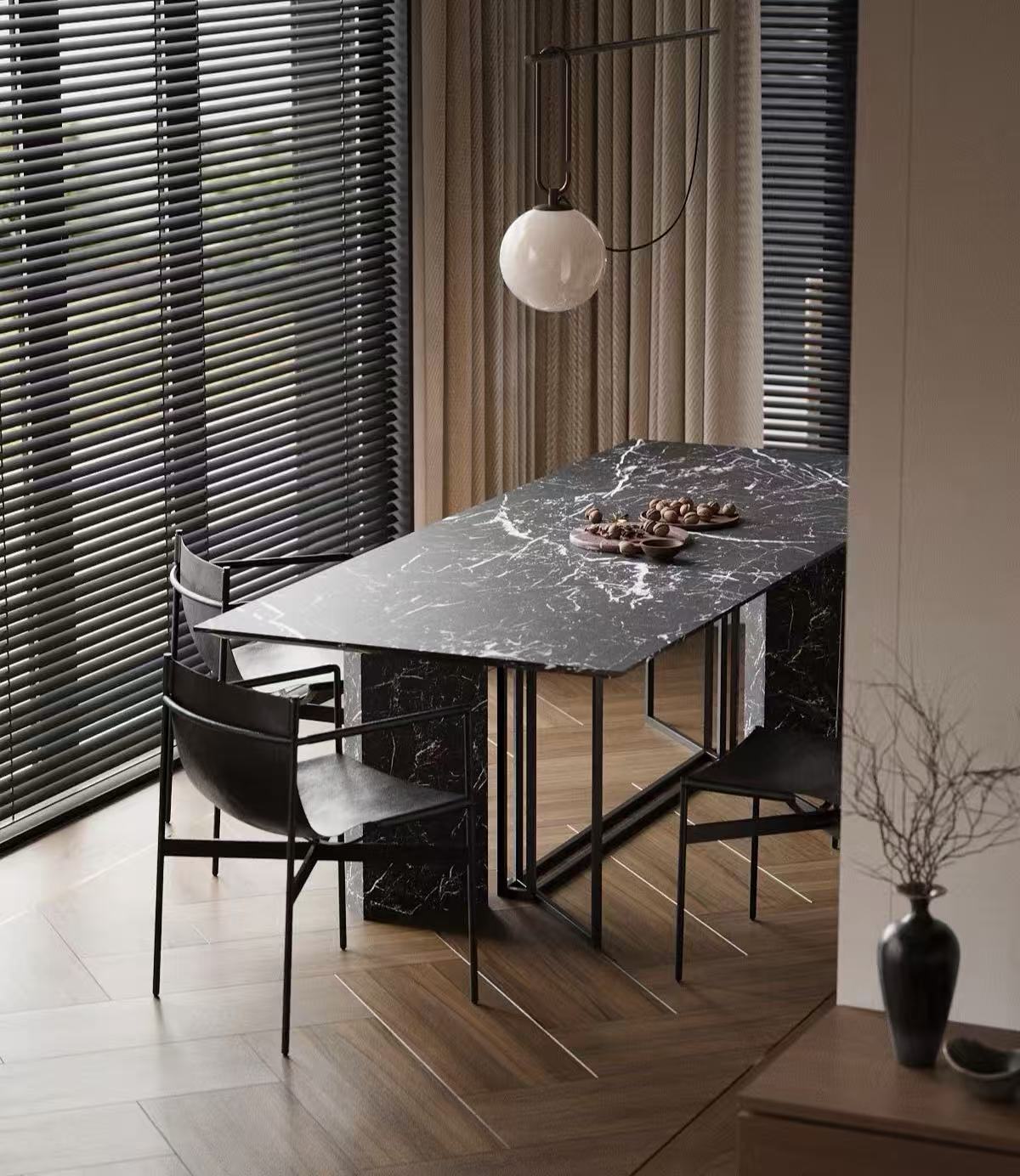
A kitchen slab is a large, continuous piece of natural stone or manufactured surfacing material that fabricators cut into countertops, islands, or backsplashes. Buying a slab does not necessarily mean your finished kitchen will be seamless: joints depend on the slab’s usable dimensions, your layout, and installation access.
For scale, a slab measuring approximately 130 × 65 inches covers about 59 square feet before cutting. However, dimensions vary by manufacturer and material. MSI, for example, lists porcelain formats of 118 × 59 inches and 126 × 63 inches. Always confirm the exact usable size before designing a large island. MSI slab specifications
Kitchen surfaces have expanded from traditional granite and marble to engineered quartz, porcelain, and sintered stone. These newer options offer ways to combine dramatic stone-inspired designs with less routine maintenance.
Sintered stone deserves consideration when stain resistance, heat resistance, and outdoor suitability matter. But choosing well requires more than comparing attractive samples. We also need to consider edge durability, repair options, installed cost, and the skill of the fabrication team.
Mainstream Kitchen Slab Options: Granite, Quartz, and Beyond
Before selecting a material, consider what your kitchen actually needs to withstand. Frequent cooking, heavy cookware, spilled coffee, strong sunlight, and children doing homework at the island create different demands.
We recommend using the following table to establish a shortlist.
Material Specification Comparison
Prices below are broad U.S. installed-cost estimates in USD per square foot, rather than material-only prices or guaranteed national averages. Premium slabs, complex edges, demolition, plumbing, and difficult access can increase the total. Price ranges follow HomeGuide’s published cost guide. Countertop installation costs
There is no reliable universal heat-resistance limit for an entire material category. Contact time, thermal shock, finishes, resins, and installation details all affect performance.
| Material Type | Porosity Level | Heat Resistance / Practical Limit | Estimated Installed Cost per Sq. Ft. | Maintenance Frequency |
|---|---|---|---|---|
| Granite | Low to variable | Good heat resistance; use trivets to protect stone and treatments | $80–$150 | Daily cleaning; assess sealing needs for the specific slab |
| Quartz | Very low; resin-bound | Protect from hot pans and sustained appliance heat | $50–$200 | Daily cleaning; no routine sealing |
| Marble | Variable; acid-sensitive | Use trivets; heat tolerance does not prevent etching | $40–$150 | Prompt spill cleanup; sealing as needed |
| Quartzite | Variable | Good heat resistance; protect against thermal shock | $65–$150 | Daily cleaning; sealing based on absorption |
| Travertine | Porous, often filled | Protect the stone, filler, and sealer from direct heat | $40–$150 | Prompt cleaning; seal and periodically inspect filled areas |
| Soapstone | Very low | Good heat resistance; softer surface can scratch | $60–$130 | Daily cleaning; optional oiling for appearance |
| Porcelain | Very low | High heat resistance; follow product-specific heat precautions | $50–$120 | Daily cleaning; slab generally needs no sealing |
| Corian solid surface | Nonporous | Always protect from hot cookware | $50–$150 | Daily cleaning; occasional professional refinishing |
Granite and Quartz: Familiar Choices with Different Care Needs
Granite offers natural variation, from Brazilian stones with sweeping movement to black and gold selections. Quartz provides more predictable patterns, including restrained whites and marble-inspired veining.
Granite’s sealing requirements deserve a more careful explanation than “seal every year.” The Natural Stone Institute states that most granite countertops do not need sealing, although many benefit from additional protection. Density, factory treatments, and the specific stone matter more than a universal maintenance calendar. Natural Stone Institute sealing guidance
We would therefore treat a homeowner’s report of decades without sealing as an individual experience, not a maintenance instruction. Ask the fabricator how your selected slab responds to moisture and which sealer, if any, it needs.
Quartz eliminates routine sealing, but its resin binder introduces heat sensitivity. A slow cooker or hot pan can create concentrated heat, particularly near edges and cutouts. MSI recommends a trivet or hot pad beneath cookware and heat-generating appliances. Quartz care guidance
Marble, Travertine, and Soapstone: Choose the Kind of Aging You Enjoy
White marble, including Calacatta selections, can create a striking focal point. However, staining and etching are different problems. A sealer can reduce liquid absorption; it does not stop acidic ingredients from reacting with marble.
Travertine brings warm, earthy character, but its pores and filled cavities require attention. Seal travertine countertops according to the stone and sealer supplier’s instructions, and choose cleaners intended for acid-sensitive stone.
Soapstone offers a softer, more understated appearance. It generally needs no sealing, but scratches and changing surface tones are part of its appeal. Optional oiling changes its appearance rather than supplying essential stain protection. MSI material guidance
Names such as “Blanc,” “Calacatta,” and “Roma” can describe colors or collections across different materials. Confirm what the slab actually is before assuming how it will perform.
Quartzite: Hard Natural Stone, with Slab-Specific Maintenance
Quartzite is a natural metamorphic rock, distinct from engineered quartz.
Some supplier guides describe quartzite as 7–8 on the Mohs hardness scale. More precisely, its dominant mineral, quartz, has a Mohs hardness of 7. That makes genuine quartzite highly resistant to ordinary scratching, but hardness does not establish its porosity or eliminate the possibility of chipping. MSI quartzite overview, Natural Stone Institute’s mineral explanation
We recommend asking the supplier to confirm the stone’s identity and care requirements. Sealing needs vary with density and absorption. Quartzite care guidance
Porcelain: A Durable Face Still Needs Protected Edges
Porcelain offers strong stain resistance and requires little routine maintenance. Its installation demands care, particularly with thin panels; MSI also notes that major damage can be difficult to repair. Porcelain countertop advantages and limitations
Homeowner discussions include both satisfied users and reports of chipped edges. These anecdotes help identify questions to ask, but they do not establish that most porcelain countertops fail. Homeowner experience discussion
For a busy kitchen, ask to see completed sink edges and corner profiles before approving the design.
Is Corian Cheaper Than Granite?
Corian can be cheaper than granite, but their installed prices overlap. The reference ranges above are $50–$150 per square foot for Corian and $80–$150 for granite. A premium solid-surface design can therefore cost more than an economical granite installation.
Corian’s practical advantage is repairability: many marks and damaged areas can be professionally restored. Its main limitation is heat. We would not use 212°F/100°C as a guaranteed safe contact temperature; Corian’s own instructions call for trivets under hot cookware and heat-generating appliances. Corian care instructions
For tighter budgets, consider countertop-rated kitchen slab tiles or a kitchen slab sheet made from laminate. Tiles introduce grout and edge detailing; laminate sheets require a suitable substrate and carefully protected seams. Compare the complete installation, not just the surface price.
What Is Sintered Stone? The Science Behind the Surface
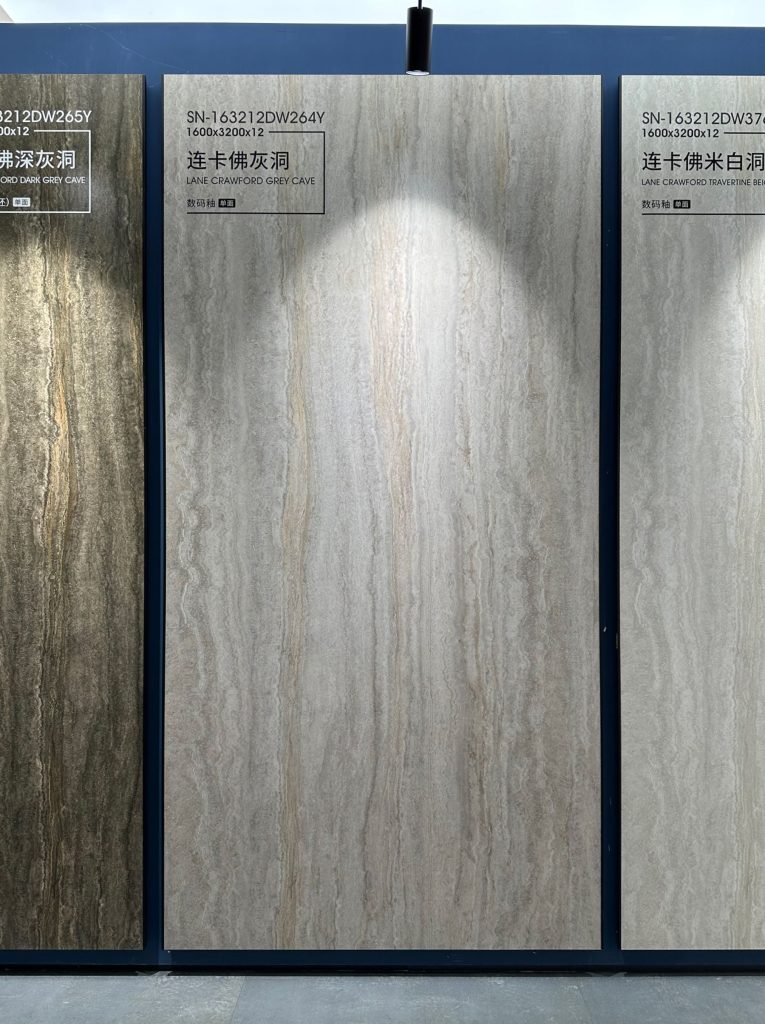
Sintered stone is a manufactured mineral surface formed through compaction and high-temperature processing. Instead of relying on the resin binder used in conventional engineered quartz, the process consolidates mineral particles into a dense slab.
Neolith describes heating its slabs to approximately 1,200°C, or 2,192°F. Manufacturing temperatures differ between products, so “1,200°C+” should be understood as a process description associated with this category, not a universal specification for every brand. Neolith manufacturing information
During firing, particles bond and the material densifies, reducing open pores. Depending on the formulation, mineral transformations and glassy phases also contribute to the finished structure. The result is a hard surface with very low absorption.
That manufacturing temperature is not the finished countertop’s safe-use temperature.
Why Can Sintered Stone Be So Thin?
Controlled production allows manufacturers to make dense, relatively uniform panels in thin sections. However, a thin panel still depends on its support system. Resistance to surface wear does not mean it can bridge a large unsupported opening.
Neolith offers panels as thin as 3 mm for suitable cladding applications. Its residential countertop range includes 12 mm and 20 mm products; 12 mm is commonly described commercially as approximately ½ inch. Neolith thin-panel applications, Neolith countertop specifications
Manufacturing and Application Specifications
| Application Type | Thickness to Discuss with the Supplier | Key Performance Trait / Design Requirement |
|---|---|---|
| Kitchen countertops | Common options: 12 mm, approximately ½ inch, and 20 mm | Dense working surface; cutouts and overhangs need approved support |
| Interior wall or furniture cladding | Selected products from 3 mm | Thin profile; requires a compatible substrate and adhesive |
| Full-height backsplash | Product-approved cladding thickness, often 3 or 6 mm | Few joints and easy cleaning; coordinate penetrations before fabrication |
| Exterior façades | Thickness specified for the engineered façade system | Verify UV, frost, water absorption, fire, and fixing-system documentation |
For exterior work, we would request numerical test results for the exact product rather than apply one brand’s values to every sintered slab. The panel, adhesive or anchors, insulation, and joints must work together.
Sintered stone and large-format porcelain also share manufacturing concepts and overlapping applications. Trade terminology varies. A product’s technical documentation is more useful than assuming its category name guarantees superior performance.
Sintered Stone vs. Quartz and Granite: Which Is Better?
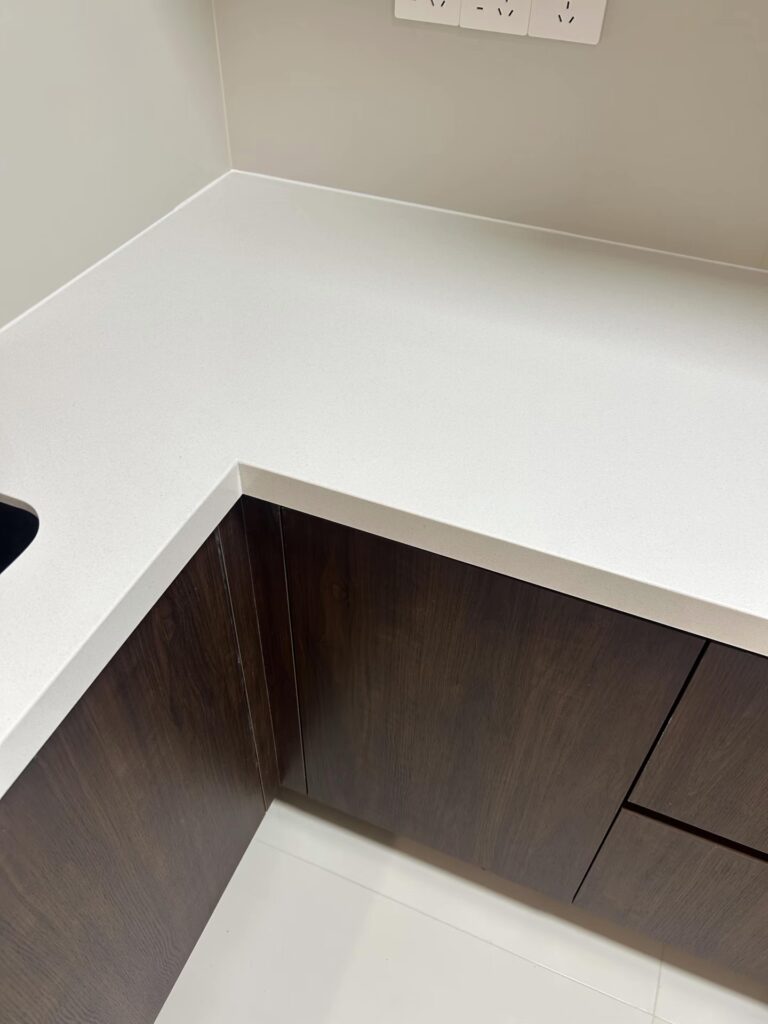
Sintered stone is often the stronger choice for heat exposure, minimal absorption, and outdoor applications. Quartz remains attractive for indoor kitchens, while granite offers natural character and a well-established fabrication market.
We would reject the claim that sintered stone is “better in everything.” Material performance, installation difficulty, repairability, and price do not all point to the same winner.
Kitchen Stress Test Showdown
The following table describes expected behavior and precautions. It is not a report of laboratory tests we performed, and it does not guarantee a pass for every brand or finish.
| Stress Test | Sintered Stone | Conventional Indoor Quartz | Granite |
|---|---|---|---|
| 400°F / 204°C hot pan | High heat resistance, but product guidance and installation conditions still matter; use a trivet | Risk of discoloration, resin damage, or cracking; use a trivet | Generally heat-resistant, but sudden temperature changes and treatments remain concerns |
| Red wine left overnight | Low absorption favors cleanup; seams and surface residues still need attention | Strong stain resistance, but prolonged exposure can leave marks | Outcome depends on stone absorption and treatment; staining is possible |
| Knife cutting directly on the surface | Scratch-resistant, but finish damage or metal marks remain possible; use a board | Can scratch or mark; use a board | Many varieties resist ordinary knife scratches, but minerals and treatments vary |
| Prolonged UV sunlight | Exterior-approved products are suitable candidates | Standard indoor products may discolor; choose an explicitly outdoor-rated product | Many varieties perform well outdoors; verify resins, fillers, and finish |
Manufacturer care guidance supports using heat protection even on resistant surfaces. MSI recommends protection from sustained heating for porcelain and from hot cookware for quartz. Outdoor quartz is also an exception worth recognizing: Caesarstone offers a collection specifically designed for exterior exposure. Porcelain care, Quartz care, Caesarstone outdoor guidance
Stain Resistance and Hygiene
Sintered stone’s low absorption makes food residue easier to remove. Neolith describes its surface as resistant to stains, scratches, high temperatures, and UV exposure. Neolith material properties
However, nonporous does not mean self-disinfecting. We should distinguish easy cleaning from a tested antibacterial claim. Any claim about reducing bacterial growth should refer to the exact product and test conditions. Normal cleaning remains necessary, including around seams and sinks.
What About Silica and Fabrication Safety?
Silica-related disease is a serious occupational concern when workers cut, grind, or polish silica-containing countertop materials. This concerns dust-generating work, rather than ordinary use of an intact countertop. NIOSH identifies exposure risks across natural and engineered stone fabrication. NIOSH countertop worker guidance
We should not assume that a sintered product is silica-free. Ask for its safety data sheet and choose a fabricator using appropriate dust controls, including controlled cutting and cleanup methods.
Appearance: Inspect More Than the Top Surface
Sintered stone can reproduce marble-inspired veining and crystal-like patterns while reducing the absorption concerns associated with some natural stones. But it may not reproduce natural translucency or carry the same pattern throughout its thickness.
Inspect an actual finished edge. For a waterfall island, request a layout showing how veins transition from the horizontal surface to the vertical panel.
The Reality of Sintered Stone: Lifespan, Costs, and Downsides
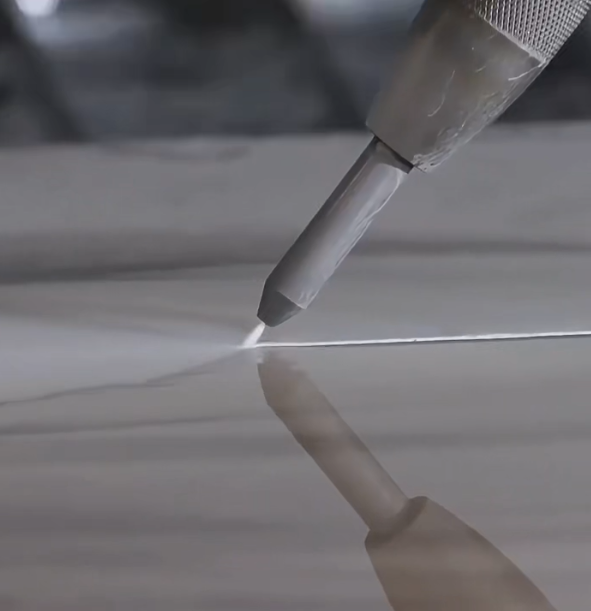
How Long Does Sintered Stone Last?
A properly specified, supported, and maintained sintered countertop can reasonably be planned as a surface for decades of use. There is no universal service-life guarantee, however.
Neolith advertises a 25-year warranty for qualifying residential countertops in 12 mm and 20 mm thicknesses. A warranty is evidence of a manufacturer’s stated coverage, not a promise that every installation will remain damage-free for that period. Neolith countertop warranty overview
Long-term performance depends on more than avoiding edge impacts. Cabinet movement, inadequate support, poorly formed cutouts, and installation defects can also matter.
Is Sintered Stone Expensive?
It generally occupies the middle-to-premium end of countertop budgets.
For a concrete market example, Seattle fabricator Absolute GM lists Neolith at $60–$155 per square foot installed, with price differences attributed to the collection and project details. That is a regional supplier estimate, not a national average. Neolith installation pricing
At that range, 40 square feet would represent approximately $2,400–$6,200, before anything excluded from the quote.
We recommend requesting separate figures for:
- Slabs and any minimum purchase requirement.
- Fabrication, edges, sink cutouts, and vein matching.
- Delivery, installation, and structural support.
- Removal, disposal, plumbing, and other additional work.
A material-only quote is particularly misleading when specialized fabrication makes up a substantial portion of the final bill.
What Is the Downside of Sintered Stone?
The central tradeoff is a hard, wear-resistant surface that requires careful handling and edge design.
Hardness measures resistance to scratching; it does not measure resistance to fracture. Long sections, sharp internal corners, unsupported areas, and exposed edges require particular attention.
Repairs can also be visually challenging. A specialist may fill a small chip, but matching the original finish and pattern is not always possible. Extensive damage may require replacement, especially where decoration is concentrated at the surface.
Fabricator Vetting Checklist
Before placing an order, we recommend asking these five questions:
- How many projects have you completed with this exact brand and thickness? Request recent references and photographs of sink edges and seams.
- Which manufacturer-approved cutting tools and settings do you use? The team should be able to explain blade selection, spindle speed, feed rate, and cooling requirements.
- How will you transport and support the cut pieces? Ask about slab frames, suction equipment, and reinforcement around openings.
- How will you detail cutout corners, overhangs, edges, and cabinet support? Request a drawing tied to the current fabrication manual.
- Who is responsible for breakage, installation defects, and repairs? Obtain written terms covering both fabrication and installation.
The purpose is to assess competence. We do not need to select the machine settings ourselves.
Practical Tips for Your Kitchen Slab Design and Sourcing
Match Undertones Before Choosing Dramatic Veining
For honey oak or other warm wood cabinets, we recommend beginning with cream, warm white, beige, or softly veined samples. A strongly blue-gray slab can make the wood appear more orange, depending on the room’s light.
Dark cabinets often benefit from a lighter surface. Calacatta-inspired or Roma-style patterns can work, but the background color and vein undertone matter more than the collection name.
Bring cabinet, flooring, and backsplash samples together. Review them in daylight and under your planned lighting. A small showroom sample may conceal how dominant a repeating vein becomes across an entire island.
Sourcing and Design Decision Matrix
| Scenario | Recommended Action | What to Avoid |
|---|---|---|
| Honey oak cabinets | Test warm whites and cream backgrounds beside an actual cabinet door | Selecting a cool gray solely from an online photograph |
| Dark cabinets or limited daylight | Compare lighter slabs with restrained movement | Combining several dark, heavily patterned finishes without a mockup |
| Total budget under $3,000 | Price laminate, countertop tile, stock granite, and suitable remnants | Assuming a low slab price includes fabrication and removal |
| Need a seamless island | Confirm usable slab dimensions, trimming allowance, and delivery access | Designing to nominal dimensions without a cutting plan |
| Frequent use of heavy cookware | Discuss eased edges and practical sink detailing | Choosing sharp exposed edges only for their appearance |
| Outdoor kitchen | Select an exterior-approved product and compatible installation system | Using an indoor-only product without written approval |
| Waterfall or book-matched design | Approve the slab-by-slab layout before cutting | Assuming all patterns can be mirrored or matched |
Find the Team Who Will Actually Install It
When searching for “kitchen slab near me,” include local fabricators as well as slab showrooms. We recommend comparing at least three itemized proposals and speaking directly with the team responsible for fabrication.
A large retailer may coordinate an excellent installation; an independent shop may provide excellent direct service. The useful questions are who does the work, what experience they have, and who resolves problems.
For demanding sintered-stone projects, the quality of support, cutouts, seams, and edge finishing can matter as much as the slab brand.
Plan Cutting Waste with a Layout
For an early budget, we suggest allowing 15%–20% extra area for cutting waste. Treat this as a preliminary allowance, not a purchasing formula.
A 40-square-foot design would therefore suggest roughly 46–48 square feet before detailed layout. Yet a single rectangular slab may still be insufficient because of piece lengths, vein direction, defects, or book-matching requirements.
Ask the fabricator to show the actual cutting plan before buying. Confirm the number of slabs, seam locations, pattern direction, and ownership of usable remnants.
Before paying a deposit, we recommend approving three things together: the exact slabs, the fabrication layout, and the itemized installed price. That gives your chosen kitchen surface the best chance of delivering the appearance, durability, and value you expect.