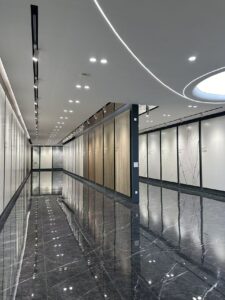
For villas, hotels, retail spaces and commercial buildings in the Middle East, a facade has to work hard visually and technically. Strong sunlight, high temperatures, airborne dust, coastal salt and demanding cleaning schedules can expose weak material or poor installation details quickly. Sintered stone facade cladding can be a strong option when the panel, fixing system and project detailing are specified together.
This guide explains the practical questions to ask before selecting sintered stone for an exterior facade or feature wall.

What is sintered stone facade cladding?
Sintered stone is a dense, manufactured slab made from mineral raw materials formed under high pressure and heat. In facade work, the slab becomes the visible finish while the supporting system carries the structural and wind loads. Depending on the design, panels may be mechanically fixed, bonded as part of an approved system, or used as a ventilated facade solution.
The right specification depends on the building height, panel size, substrate, wind exposure, local code requirements and the installer’s system—not only on the surface appearance.
Five selection checks for Middle East projects
1. Sun, heat and colour stability
Ask for documented information about UV exposure, colour stability and the intended exterior use. A sample viewed indoors is not enough. Compare the actual finish, texture and colour under strong daylight, and confirm that the selected design is suitable for the project environment.
2. Format, thickness and handling
Large panels can create a clean architectural grid, but they also require careful transport, lifting, cutting and edge protection. Confirm slab dimensions, thickness, weight per panel, tolerances and the maximum workable size for the proposed access route. A beautiful layout that cannot be safely delivered or installed will create avoidable cost.
3. Fixing and substructure
Facade performance depends on the complete assembly. Coordinate the slab with anchors, rails, adhesives where permitted, insulation, backing walls and movement provisions. Request shop drawings and installation guidance early, then have the local facade contractor verify the system for the building’s height, wind conditions and substrate.
4. Joints, drainage and movement
Do not treat joints as a purely visual decision. The design should allow for movement, water management, ventilation where applicable and safe replacement of individual panels. Pay special attention to corners, parapets, openings, balconies and transitions between different materials.
5. Cleaning and future maintenance
Middle Eastern facades may collect dust, sand and deposits from irrigation or coastal air. Choose a finish that suits the planned cleaning method, and confirm which detergents, tools and access equipment are acceptable. Keep spare slabs or a clear replacement plan for future repairs.

How does it compare with other facade finishes?
Painted render can be economical and flexible, but it may need more frequent cleaning or recoating. Natural stone offers unique variation, yet its porosity, weight, colour consistency and maintenance requirements must be assessed for each stone. Ceramic or porcelain panels can also suit exterior walls, with the final choice depending on format, system design, appearance and local availability.
Sintered stone is most useful when the project needs a consistent decorative surface, large-format design options and a low-porosity material, while the engineering and installation requirements are managed properly. It should not be selected on marketing claims alone.
Procurement checklist
- Request full-size samples and confirm the exact finish and batch.
- Ask for technical data, available thicknesses, tolerances and exterior-use guidance.
- Share elevations and panel layouts before final quotation.
- Confirm cutting, edge finishing, packing, export documentation and delivery responsibility.
- Agree who designs, supplies and signs off the fixing system.
- Confirm cleaning instructions and the process for replacement panels.
Frequently asked questions
Will sintered stone fade in Middle East sunlight?
Exterior suitability and colour stability should be confirmed for the exact product and finish. Request supporting technical information and assess a sample in the intended daylight conditions.
Is it suitable near the coast?
It can be considered, but the full facade assembly, fixings, joints and cleaning plan must account for salt air and moisture. The panel alone does not determine project performance.
Can any tile installer install facade panels?
Large-format facade work requires an installer experienced with the specified fixing method, panel handling and movement detailing. Confirm competence before ordering material.
Plan your facade with BJS
Choosing the right slab is only the first step. BJS sintered stone can help fabricators, architects, contractors and distributors review suitable finishes, samples and project requirements. Explore BJS sintered stone products or contact BJS sintered stone sales for product recommendations, samples and project support.