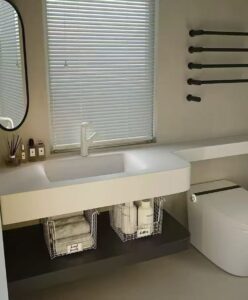

Choosing sintered stone fireplace surrounds in Central Asia requires more than selecting a colour from a catalogue. A good result depends on the heating appliance, the distance between the fire and the surface, the wall structure, fabrication details and the installer’s experience. This guide explains the decisions to make before ordering.
Why use sintered stone around a fireplace?
Sintered stone is made from mineral-based raw materials compacted and fired at high temperature. For a fireplace project, buyers are usually looking for a surface that delivers a stone-like appearance with consistent colour, low water absorption and straightforward cleaning. It can also create a large-format look with fewer visible joints than small tiles.
However, the material is only one part of a safe installation. The fireplace manufacturer’s clearance and heat requirements always come first. The surround should be specified with the appliance, backing wall and ventilation arrangement in mind.
1. Start with the heat zone and appliance type
Before choosing a slab, identify whether the project uses a gas, electric, wood-burning or decorative fireplace. Confirm the manufacturer’s required clearances and the maximum temperature expected at the surface. Do not assume that a material described as heat resistant can be installed directly against every firebox.
- Keep the firebox, vents and controls accessible for inspection and servicing.
- Use a suitable non-combustible substrate where the fireplace specification requires it.
- Plan movement joints and sealant around the appliance rather than trapping the slab tightly against it.
- Ask the installer to confirm the complete wall build-up, not only the slab thickness.
2. Measure the opening, wall and mantel carefully
Measure the finished opening, side returns, breast, hearth and mantel separately. Record the location of electrical points, gas connections, ventilation grilles and any projecting trim. Large slabs can make a clean statement, but access routes and lifting space must be checked before fabrication.
Central Asian projects may involve long transport distances and buildings with narrow staircases or lifts. Confirm the slab format, crate dimensions and site access early. A simple site template can reduce the risk of an expensive cut-out error.
3. Choose a design that suits the room
For contemporary apartments, a bookmatched or quiet grey surface can give the fireplace a calm architectural appearance. Dark surfaces create contrast but require careful lighting and dust management. Warm stone patterns can work well with timber, brass and textured fabrics in colder-climate interiors.
Ask for a physical sample or a full-resolution slab image. Small samples cannot show how veining will run across a tall surround. Mark the desired vein direction on the quotation and approve the slab layout before cutting.
4. Specify fabrication details before ordering
Fireplace surrounds often need mitred corners, polished edges, ventilation cut-outs and openings for controls or sockets. Agree on the edge profile, corner radius, joint position and finish in writing. Sharp internal corners can be vulnerable during handling, while a small radius is usually easier to protect.
Use an experienced fabricator familiar with sintered stone tools and large-format handling. The Reddit discussions reviewed for this topic repeatedly show that workmanship, alignment and the quality of the installation can matter as much as the chosen material. Request shop drawings and confirm who is responsible for templating, cutting and fitting.
5. Plan installation and maintenance
The wall must be flat, sound and suitable for the specified adhesive system. The installer should follow the fireplace manufacturer’s instructions and the slab supplier’s technical guidance. Protect the finished surface during the remaining construction work, especially from abrasive dust and metal filings.
For daily care, wipe the surround with a soft cloth and a neutral cleaner. Avoid abrasive powders and unapproved chemicals. Keep the joints, sealants and heat-exposed areas under observation, particularly after the first heating season.
Questions to ask your supplier
- Which slab finish and thickness suit the planned application?
- Can you provide a layout drawing showing the vein direction?
- Who will template, fabricate and install the surround?
- What substrate, adhesive and joint details are required?
- How will the slab be packed and transported to the project site?
Final checklist
Before placing the order, confirm the appliance type, clearances, wall build-up, measurements, slab layout, edge details, access route, fabrication scope and installation date. A coordinated specification helps avoid the common problems of poor alignment, unexpected cut-outs and damaged corners.
For project-specific recommendations, samples and fabrication guidance, contact BJS sintered stone sales for product recommendations, samples, and project support.