Australian laundries are hardworking rooms: they handle water, detergents, baskets, appliances and frequent cleaning, often in a compact footprint. Choosing the right benchtop therefore involves more than matching a colour to the cabinetry. Sintered stone laundry benchtops can provide a refined, low-maintenance surface when the slab, fabrication and installation are specified together.
Why consider sintered stone for an Australian laundry?
A laundry benchtop needs to cope with splashes, damp items and cleaning products while remaining easy to wipe down. Sintered stone is a dense, mineral-based surface made through pressure and high-temperature processing. Its non-porous character can make everyday cleaning straightforward, but the finished result still depends on correct detailing and the supplier’s care instructions.
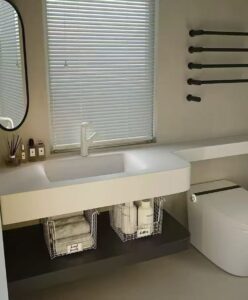
For Australian renovation projects, the practical advantages are a clean contemporary appearance, resistance to routine surface wear and a broad choice of colours and patterns. It can also coordinate with a kitchen, bathroom or utility joinery scheme without making the laundry look like an afterthought.
Five checks before ordering laundry benchtops
1. Measure the room and appliances first
Confirm the position of the washing machine, dryer, sink, taps, wall clearances and any tall storage before selecting the slab. Record finished cabinet dimensions, service penetrations and the direction of doors and drawers. A small laundry leaves little room for tolerance, so the final template should be taken after the cabinetry is secure.
2. Plan water management around the sink
Discuss the sink type, cut-out dimensions, tap holes and the edge detail with the fabricator. A small upstand or carefully sealed junction may help manage splashes, but it should not be treated as a substitute for sound waterproofing behind the benchtop. Keep silicone, sealants and adjacent materials compatible with the manufacturer’s recommendations.
3. Specify fabrication details early
Sintered stone is strong in its finished application, but thin slabs, cut-outs, unsupported overhangs and narrow sections require professional planning. Ask how corners will be supported, how the sink cut-out will be finished and where joins will be located. Use a fabricator familiar with the selected product rather than treating the material like a conventional laminate panel.
4. Choose a finish that suits the room
Light, concrete-inspired and stone-look surfaces are popular in Australian utility rooms because they make a compact space feel brighter. Darker patterns can create contrast but may show lint, powder or water marks more readily. Compare physical samples under the room’s lighting and beside the cabinetry, flooring and splashback.
5. Confirm support, delivery and installation
Before production, confirm the slab thickness, cabinet support, access route, delivery protection and installation sequence. This is especially important for apartments, narrow corridors and laundries on upper levels. The installer should check that the cabinets are level and that the completed surface is not forced into position.
Cleaning and everyday care
Use a soft cloth, warm water and a mild cleaner suitable for the specific surface. Wipe detergent residue and standing water rather than allowing deposits to build up. Avoid assuming that every bleach, abrasive powder or highly alkaline product is approved; follow the product care guide supplied with the slab. Use a board for cutting and avoid striking exposed edges with heavy objects.
Questions to ask an Australian supplier
- Which slab thickness and finish are suitable for my cabinet layout?
- Who will template and fabricate the sink, tap and service cut-outs?
- What support is required below the benchtop and at joins?
- Which cleaners and maintenance methods are approved?
- Can you provide physical samples and project references?
FAQ
Are sintered stone laundry benchtops waterproof?
The surface itself is designed to be highly moisture resistant, but the complete installation also includes joins, cut-outs, sealants, cabinetry and wall interfaces. Good detailing remains essential.
Can a laundry benchtop match a kitchen?
Yes. Using the same or a coordinated slab design can create a consistent material palette across utility, kitchen and bathroom areas.
Is professional fabrication important?
Yes. Accurate templating, correct support and experienced handling reduce the risk of problems around sinks, corners, joins and delivery.
For product recommendations, samples and project support, contact BJS sintered stone sales. Our team can help you compare suitable surfaces and prepare the information your Australian fabricator needs.